
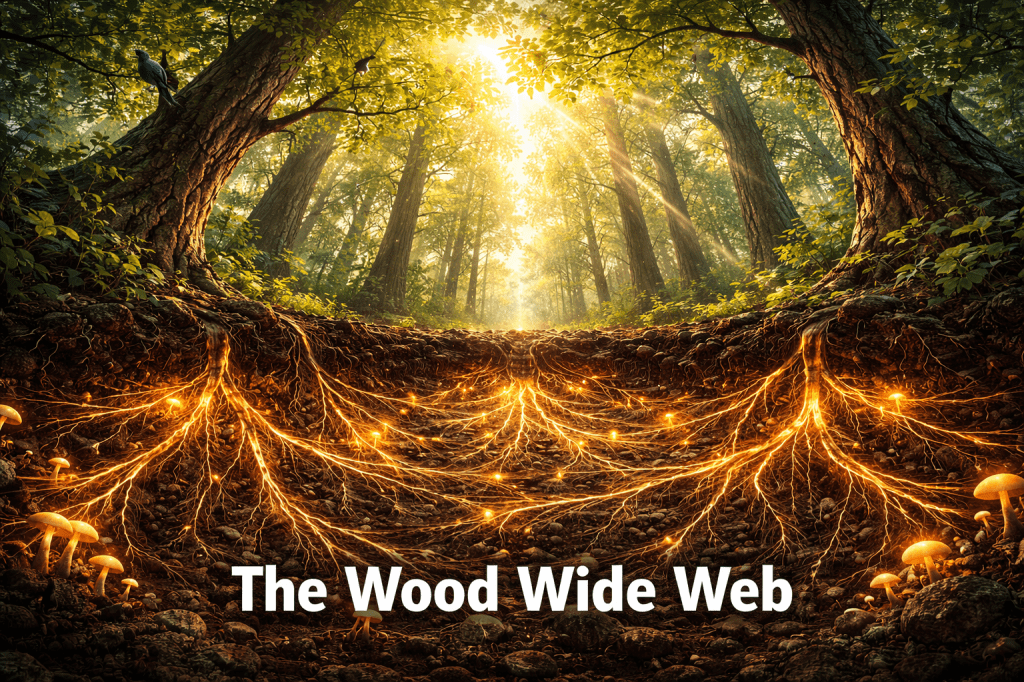
Walk through a forest and it looks peaceful — still, silent, each tree standing alone in its patch of soil. But beneath your feet, something extraordinary is happening. Trees are talking to each other, sharing food, sending warnings, and even nurturing their young through a vast underground network of fungi that connects the entire forest.
Scientists call it the mycorrhizal network. Everyone else calls it the Wood Wide Web — and it’s one of the most fascinating discoveries in modern biology.
What Is the Mycorrhizal Network?
Mycorrhizal fungi are ancient organisms that form symbiotic relationships with the roots of plants. The fungi attach to tree roots and extend outward into the soil through thread-like structures called hyphae — so thin that millions of them can fit in a single handful of dirt. These hyphae connect one tree’s roots to another, and another, and another, weaving an underground web that can span an entire forest.
The relationship is a two-way street. The fungi get sugars and carbon from the trees (which produce them through photosynthesis). In return, the fungi dramatically extend the tree’s ability to absorb water and nutrients — particularly phosphorus and nitrogen — from the soil. Both partners benefit, and the forest as a whole becomes more than the sum of its parts.
How Trees “Talk” to Each Other
The word “communicate” might sound like a stretch when we’re talking about trees, but researchers have documented some remarkable behaviors that are hard to describe any other way.
Sharing Nutrients
Studies have shown that trees actively transfer carbon, nitrogen, and phosphorus to neighboring trees through the fungal network — and not randomly. Larger, older trees (sometimes called “mother trees”) tend to send more resources to younger seedlings, especially their own offspring. In shaded forest understories where seedlings can’t yet photosynthesize efficiently, this nutrient sharing can make the difference between survival and death.
Sending Distress Signals
When a tree is attacked by insects or disease, it can send chemical warning signals through the network to neighboring trees. Those trees then respond by ramping up their own chemical defenses — before the threat even reaches them. It’s a forest-wide early warning system, operating entirely underground.
Recognizing Kin
Some research suggests trees can distinguish between their own seedlings and unrelated seedlings — and preferentially share resources with their genetic relatives. This raises profound questions about plant cognition and what we mean by “behavior” in the natural world.
Supporting Dying Trees
When a tree is dying, it sometimes releases a surge of carbon and nutrients into the network — a kind of final gift to the surrounding forest. Whether this is intentional or simply a byproduct of the dying process is still debated, but the effect is real: neighboring trees receive a boost of resources at the moment the network loses a member.
The Role of Mother Trees
Ecologist Suzanne Simard, whose decades of research in Canadian forests helped bring the Wood Wide Web to public attention, identified what she calls “mother trees” — the largest, oldest trees in a forest that act as hubs in the mycorrhizal network. Like routers in the internet, mother trees have the most connections and move the most resources.
When mother trees are removed — through logging, disease, or development — the network doesn’t just lose one node. It can collapse in that section of the forest, leaving younger trees without the nutrient support and warning signals they depend on. This has significant implications for how we think about sustainable forestry and forest management.
How Old Is This Network?
Mycorrhizal fungi are ancient — fossil evidence suggests they’ve been forming relationships with plants for over 400 million years. They predate the dinosaurs, predate flowers, and may have played a crucial role in enabling plants to colonize land in the first place. The Wood Wide Web isn’t a new invention; it’s one of the oldest partnerships on Earth.
In a single teaspoon of healthy forest soil, there can be several miles of fungal hyphae. A single fungal network can cover hundreds of acres. Some individual fungi are among the largest living organisms on the planet — one honey fungus in Oregon is estimated to cover nearly 2,400 acres and may be thousands of years old.
What Disrupts the Network?
The mycorrhizal network is remarkably resilient, but it’s not indestructible. Several human activities can damage or destroy it:
- Tilling and soil disturbance — physically breaks the fragile hyphae threads
- Synthetic fertilizers — when trees get nutrients directly, they invest less in their fungal partnerships, weakening the network over time
- Fungicides and certain pesticides — can kill the fungi directly
- Compaction — heavy machinery compresses soil and destroys the pore spaces fungi need to thrive
- Clear-cutting — removes the trees that sustain the network, causing it to collapse
This is one reason why forests that have been heavily managed or logged often struggle to recover as quickly as those that have been disturbed more gently — the underground infrastructure that makes recovery possible has been damaged along with the trees themselves.
What This Means for How We See Forests
The discovery of the Wood Wide Web has changed the way many scientists and foresters think about trees. Instead of viewing a forest as a collection of individual competing organisms, we’re increasingly seeing it as a single interconnected system — a superorganism, in a sense, where cooperation is as important as competition.
It also changes how we should think about tree planting and reforestation. Planting trees in degraded soils without healthy fungal communities is a bit like building a house without wiring it for electricity — the structure is there, but it can’t function the way a truly healthy forest does. Increasingly, restoration ecologists are looking at ways to inoculate seedlings with mycorrhizal fungi before planting to give them the best possible start.
Texas Trees and the Wood Wide Web
Texas is home to a remarkable diversity of forest and woodland ecosystems — from the loblolly pine forests of East Texas to the live oak mottes of the Hill Country — and each of these ecosystems has its own community of mycorrhizal fungi working beneath the surface. Understanding the trees in your region means understanding not just what’s above the ground, but what’s happening in the soil beneath them.
If you want to dig deeper into the trees of the Lone Star State — how to identify them, where they grow, and how to care for them — our Texas Tree Guides are packed with everything you need to know. Whether you’re a landowner, a nature lover, or just tree-curious, there’s something in there for you.
Final Thoughts
The Wood Wide Web is a reminder that nature is almost always more complex, more connected, and more intelligent than we give it credit for. The next time you walk through a forest, look down. Beneath the leaf litter and the soil, an ancient network is humming with activity — sharing, warning, nurturing, and connecting every tree around you into something larger than any of them could be alone.
Forests aren’t just collections of trees. They’re communities. And like any community, they thrive when they’re connected.
Curious about the trees making up these incredible networks in Texas? Explore our Texas Tree Guides for in-depth identification guides, care tips, and everything you need to know about the Lone Star State’s remarkable trees.
 Best Texas Trees
Leave a comment