
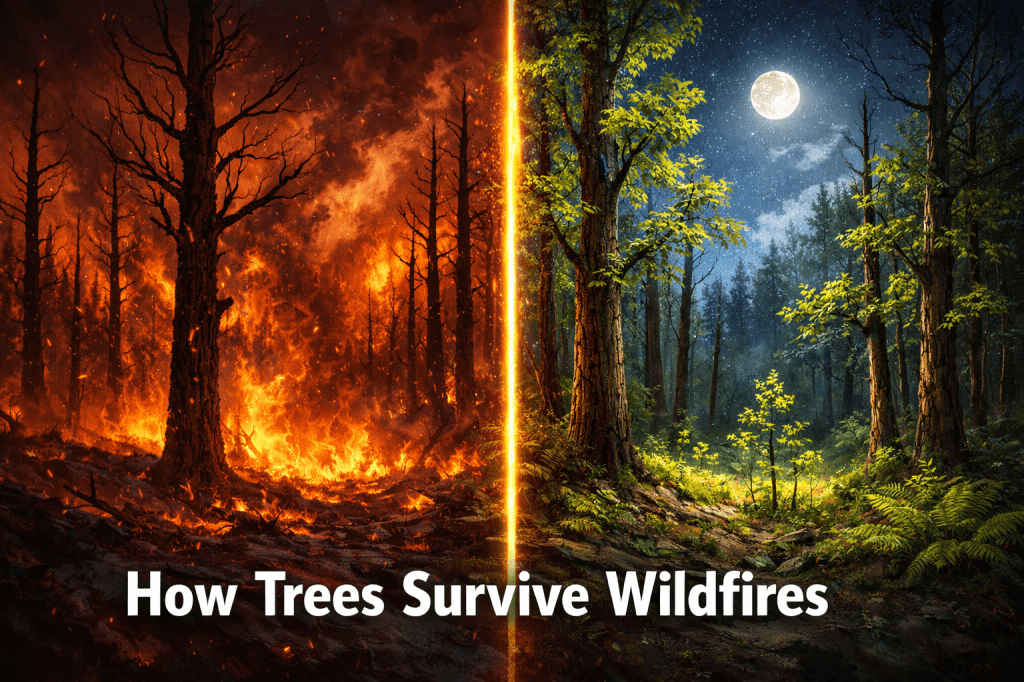
Wildfires are one of nature’s most dramatic and destructive forces — capable of reducing a forest to ash in a matter of hours. Yet walk through a burn area a few years later, and you’ll often find something remarkable: trees growing back, wildlife returning, and the forest slowly stitching itself back together.
So how do trees do it? How do some survive the flames entirely, while others seem to rise from the dead? The answer lies in millions of years of co-evolution between trees and fire — and it’s one of the most fascinating stories in the natural world.
Not All Fires Are the Same
Before we dive into tree survival strategies, it’s important to understand that “wildfire” covers a wide spectrum. There’s a big difference between:
- Low-intensity surface fires that burn through ground cover and underbrush
- Crown fires that roar through the tops of trees at extreme temperatures
- Mixed-severity fires that create a mosaic of burned and unburned patches
Trees that survive a slow-moving surface fire may not survive a fast-moving crown fire. The intensity, duration, and frequency of a fire all play a role in what lives and what doesn’t.
Built to Burn: How Some Trees Are Fire-Adapted
Many tree species — particularly those in fire-prone regions — have developed remarkable adaptations over thousands of years. Here are the main survival strategies trees use:
1. Thick, Insulating Bark
Thick bark is a tree’s first line of defense against fire. Species like ponderosa pine, giant sequoia, and longleaf pine can develop bark several inches thick, which insulates the living tissue (cambium) underneath from the heat of a passing fire. Even when the outer bark chars, the tree inside survives.
2. Self-Pruning Lower Branches
Fire climbs. It moves from ground fuels up into the canopy via “ladder fuels” — dead branches and brush at mid-height. Fire-adapted trees like longleaf pine naturally shed their lower branches as they mature, creating a tall, clear trunk that keeps flames from reaching the crown.
3. Deep Root Systems
While a wildfire scorches the surface, the soil just a few inches down barely rises in temperature. Many fire-adapted trees have deep, extensive root systems that survive even when everything above ground is destroyed — allowing the tree to resprout from the base after the fire passes.
4. Fire-Resistant or Serotinous Cones
Some trees don’t just survive fire — they need it to reproduce. Lodgepole pine and jack pine produce serotinous cones: cones sealed shut with a resin that only melts at high temperatures. A wildfire triggers mass seed release right when conditions for germination are ideal — the ground is cleared, competition is gone, and nutrients from ash are abundant.
5. Cork-Like Outer Layers
Certain oaks and other hardwoods produce bark with a spongy, cork-like texture that chars on the outside but prevents heat from penetrating to the living wood beneath. This layer also helps protect the tree from insect invasion after a fire stresses the surrounding forest.
What Happens to Trees That Don’t Survive?
Even trees that die in a wildfire play an important role in forest recovery. Standing dead trees — called snags — become habitat for cavity-nesting birds, bats, and insects. Fallen logs decay slowly and return nutrients to the soil. A burned forest is not a dead forest; it’s a forest in transition.
It’s also worth noting that many trees that look dead after a fire are actually just dormant. Fire-stressed trees may drop their leaves, look scorched, and show no signs of life for months — before slowly pushing out new growth the following spring.
The Recovery Process: Forest Succession After Fire
Forest recovery after a wildfire follows a predictable pattern called ecological succession. Understanding this process helps explain why some forests bounce back quickly and others take decades.
Phase 1: The Ash Stage (Weeks to Months)
Immediately after a fire, the landscape looks barren. But the soil is rich in nutrients from the ash, and the first pioneers are already at work. Certain grasses, wildflowers, and shrubs are adapted to colonize burned ground almost immediately, sometimes within weeks of a fire.
Phase 2: Shrub and Pioneer Tree Stage (1–5 Years)
As pioneer plants stabilize the soil and add organic matter, tree seedlings begin to establish. Which species come back first depends on what seeds were in the area, what survived the fire, and what birds and animals carry in. Aspens are famous for this — they resprout vigorously from their root systems and can carpet a hillside within a few years of a fire.
Phase 3: Young Forest (5–30 Years)
The pioneer trees grow taller, shade the ground, and change conditions for the species that follow. This is when the forest community becomes more complex, with layered vegetation and returning wildlife. Many of the trees that survived the fire — especially thick-barked species — are now thriving without the heavy competition that existed before.
Phase 4: Mature Forest (30–100+ Years)
Depending on the ecosystem, a forest can return to something resembling its pre-fire state within decades, though the species composition may be different. Some old-growth characteristics, like ancient trees and complex fungal networks, may take centuries to fully develop.
How Fire Frequency Shapes Forests
Forests that burn regularly look very different from forests that rarely see fire. In ecosystems like the longleaf pine savanna or the ponderosa pine forests of the American West, frequent low-intensity fires historically kept the understory open, reduced fuel loads, and maintained a park-like forest structure.
Decades of fire suppression in many of these forests have dramatically altered this balance — leading to dense, overcrowded forests with heavy fuel loads that are far more vulnerable to catastrophic crown fires than the open woodlands that evolved there.
This is one reason why land managers increasingly use prescribed burns — intentionally set, carefully managed fires — to restore natural fire cycles and reduce wildfire risk.
What This Means for Texas Trees
Texas is one of the most ecologically diverse states in the country, with forests, savannas, and grasslands that have their own unique relationships with fire. From the East Texas Piney Woods to the cedar-juniper landscapes of the Hill Country, understanding how trees interact with fire is essential for landowners, foresters, and nature lovers alike.
If you want to learn more about the specific trees growing in your region — and how to identify, plant, and care for them — our Texas Tree Guides are a great place to start. Whether you’re managing land after a fire, choosing fire-resistant species for your property, or just curious about what’s growing around you, we’ve got you covered.
Final Thoughts
Wildfires can feel like pure destruction, but for forests that evolved alongside fire, they’re often more of a reset than an ending. Trees that survive a fire emerge into a landscape with less competition, rich soil, and more sunlight — conditions that can trigger a growth explosion. And even trees that don’t survive leave something behind: habitat, nutrients, and the seeds of the next generation.
The next time you see a fire-scarred forest, look a little closer. Chances are, it’s already coming back.
Want to explore more about Texas trees? Visit our Texas Tree Guides for in-depth resources on identifying, planting, and caring for trees across the Lone Star State.
 Best Texas Trees
Leave a comment