
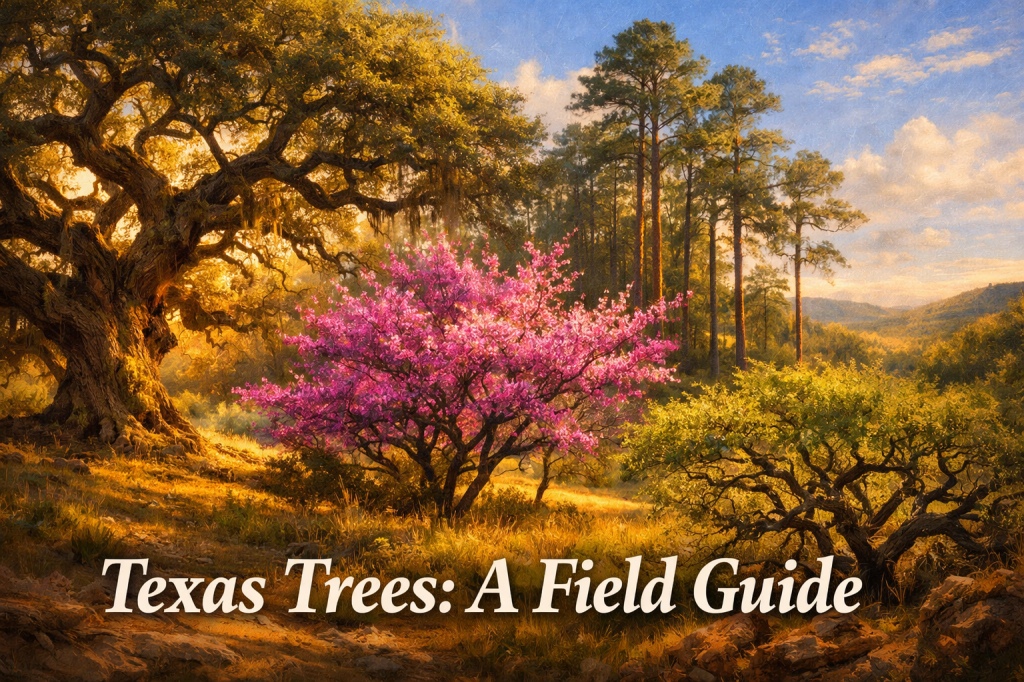
Texas is one of the most ecologically diverse states in the country — and that diversity shows up in its trees. From the towering loblolly pines of East Texas to the twisted mesquites of the western plains, the Lone Star State is home to hundreds of tree species spread across ten distinct ecological regions. Whether you’re a landowner, a hiker, or just someone who’s curious about what’s growing in your backyard, knowing how to identify common Texas trees is a skill that pays off every time you step outside.
Here’s a guide to the most common trees you’ll encounter across Texas — and exactly how to identify them.
1. Live Oak (Quercus virginiana)
If there’s one tree that defines the Texas landscape, it’s the live oak. Found across the eastern two-thirds of the state, live oaks are the iconic spreading trees you see lining Hill Country roadsides, shading ranch houses, and anchoring countless Texas town squares.
How to Identify It:
- Leaves: Small, dark green, and leathery with smooth edges — unlike most oaks, live oak leaves are not lobed. They stay on the tree through winter, dropping only in spring when new leaves push them off (hence “live” oak).
- Bark: Dark gray to dark brown, deeply furrowed and rugged in older trees.
- Shape: Wide, sprawling canopy — often wider than tall. Old specimens can have limbs stretching 50 feet or more in each direction.
- Acorns: Small, dark brown to black, elongated acorns in clusters.
Where you’ll find it: Central Texas, Hill Country, Gulf Coast, East Texas — basically everywhere except the far west.
2. Loblolly Pine (Pinus taeda)
Head into East Texas and the landscape shifts dramatically — suddenly you’re in pine country. The loblolly pine is the dominant tree of the Piney Woods region and one of the most commercially important trees in the American South.
How to Identify It:
- Needles: Long needles (6–9 inches) in bundles of three. This is the key distinguishing feature from other pines.
- Bark: Reddish-brown and scaly in younger trees, developing into thick, blocky plates with age.
- Cones: Medium-sized cones (3–5 inches) with small sharp spines on each scale.
- Shape: Tall and straight with a relatively open crown. Mature trees can reach 90–110 feet.
Where you’ll find it: East Texas Piney Woods — Angelina, Nacogdoches, Sabine, and surrounding counties.
3. Texas Live Oak (Quercus fusiformis)
Often confused with the live oak, the Texas live oak (also called plateau live oak) is a closely related species that dominates the Edwards Plateau and Hill Country. It’s slightly smaller and more drought-tolerant than its coastal cousin.
How to Identify It:
- Leaves: Similar to live oak but often slightly smaller and more elliptical, sometimes with slightly rolled edges.
- Bark: Dark and furrowed, similar to live oak.
- Shape: More rounded and compact than the sprawling live oak, often forming thickets called “mottes.”
- Acorns: Slender, elongated acorns — more fusiform (spindle-shaped) than regular live oak acorns.
Where you’ll find it: Edwards Plateau, Hill Country, and the limestone uplands of Central Texas.
4. Mesquite (Prosopis glandulosa)
No tree is more synonymous with Texas than the mesquite — and no tree is more controversial. Ranchers have battled it for generations, while others prize it for its wood, its beans, and its role in the ecosystem. Love it or hate it, mesquite is everywhere.
How to Identify It:
- Leaves: Feathery, bipinnate compound leaves — each leaf divided into many tiny leaflets, giving the tree a lacy, light appearance.
- Thorns: Sharp, straight thorns up to 2 inches long along the branches. Watch your ankles.
- Pods: Long, tan to yellowish seed pods (4–8 inches) that look a bit like green beans — highly nutritious and historically important to Native Americans and wildlife.
- Shape: Sprawling, irregular, often multi-trunked. Rarely taller than 30 feet.
- Bark: Shaggy, reddish-brown, and fibrous.
Where you’ll find it: Virtually everywhere in Texas except the deepest Piney Woods — especially common in West Texas, South Texas, and the Rolling Plains.
5. Cedar Elm (Ulmus crassifolia)
The cedar elm is the most common elm in Texas and one of the toughest native trees in the state. It thrives in the heat and alkaline soils that defeat so many other species, making it a staple of Central Texas landscapes.
How to Identify It:
- Leaves: Small (1–2 inches), dark green, rough and scratchy to the touch, with doubly serrated edges. Much smaller than the leaves of other elms.
- Bark: Gray-brown, deeply furrowed with flat-topped ridges — distinctive and recognizable.
- Winged seeds: Small, round, papery samaras (winged seeds) that appear in fall — unusual for elms, which typically seed in spring.
- Shape: Vase-shaped crown, upright form, typically 50–70 feet tall.
Where you’ll find it: Central Texas, Hill Country, Blackland Prairie, and South Texas — often along creek banks and roadsides.
6. Pecan (Carya illinoinensis)
The pecan is the official state tree of Texas — and for good reason. Native to the river bottoms of central and eastern Texas, it has fed wildlife, Native Americans, and Texans for thousands of years. Today it’s planted across the state for both its beauty and its famous nuts.
How to Identify It:
- Leaves: Large pinnately compound leaves with 9–17 lance-shaped leaflets, each finely serrated. The leaflets are slightly curved like a sickle.
- Nuts: The dead giveaway — oblong nuts in a thin, four-sectioned husk that splits open at maturity.
- Bark: Light gray and shaggy, breaking into long irregular scales on mature trees.
- Shape: Large, rounded canopy. One of the biggest native Texas trees — can reach 100–140 feet.
Where you’ll find it: River bottoms and creek drainages statewide — especially the Colorado, Guadalupe, and Brazos river corridors.
7. Post Oak (Quercus stellata)
Post oak is one of the defining trees of the Post Oak Savanna region of East-Central Texas — a transitional zone between the Piney Woods and the Blackland Prairie. It’s a tough, slow-growing oak that can live for centuries.
How to Identify It:
- Leaves: The most distinctive feature — leaves are shaped like a cross or plus sign, with two large rounded lobes near the tip that are wider than the rest of the leaf.
- Bark: Gray-brown, blocky, and deeply furrowed.
- Acorns: Small to medium, round acorns with a deep cap covering about half the nut.
- Shape: Rounded crown, typically 40–60 feet tall, with a rugged, gnarled appearance in older specimens.
Where you’ll find it: Post Oak Savanna belt from the Red River south through Lee, Bastrop, and Fayette counties — also called the “Lost Pines” region.
8. Ashe Juniper (Juniperus ashei)
Known to most Texans simply as “cedar” (though it’s not a true cedar), Ashe juniper is one of the most common and most debated trees in Texas. It dominates the Hill Country and Edwards Plateau, and its relationship with the landscape is complicated — it provides critical habitat for the endangered Golden-cheeked Warbler but can also overtake grasslands when fire is suppressed.
How to Identify It:
- Leaves: Tiny, scale-like leaves that overlap along the twigs — not needles. Dark green and aromatic when crushed.
- Bark: Reddish-brown and shreddy, peeling in long strips — one of its most recognizable features.
- Berries: Small, round, blue-gray berry-like cones (technically not true berries) on female trees.
- Shape: Irregular, multi-stemmed shrub to small tree, rarely exceeding 20–30 feet. Often forms dense thickets.
Where you’ll find it: Hill Country, Edwards Plateau, and limestone-based soils of Central Texas.
9. Blackjack Oak (Quercus marilandica)
The blackjack oak is a small but tough native oak found across East and Central Texas. It’s one of the most drought-tolerant oaks in the state and tends to grow in poor, sandy soils where other trees struggle.
How to Identify It:
- Leaves: Distinctive duck-foot or bell shape — narrow at the base and broad at the tip with three shallow lobes. Unlike most oaks, the widest part is at the top.
- Bark: Very dark, almost black, and deeply blocky — giving the tree its name.
- Acorns: Small, round acorns about half covered by a thick, saucer-like cap.
- Shape: Small, irregular tree rarely exceeding 30–40 feet, often with a twisted, rugged form.
Where you’ll find it: Sandy soils of East Texas and the Post Oak Savanna — often growing alongside post oak.
10. Texas Redbud (Cercis canadensis var. texensis)
Every spring, Texas roadsides and hillsides light up with the brilliant magenta blooms of the Texas redbud — one of the most beloved native trees in the state. It’s small, beautiful, and perfectly adapted to Texas conditions.
How to Identify It:
- Flowers: The easiest ID in spring — clusters of vivid pink-magenta flowers that bloom directly on the branches and trunk before the leaves appear. A stunning and unmistakable sight.
- Leaves: Heart-shaped, glossy, dark green leaves with a pointed tip. Thick and slightly leathery compared to the eastern redbud.
- Seed pods: Flat, papery pods (3–4 inches) that hang on the tree through fall and winter.
- Shape: Small, multi-trunked tree rarely exceeding 20–25 feet, with a rounded, graceful crown.
Where you’ll find it: Hill Country, Edwards Plateau, and Central Texas — especially on limestone slopes and canyon walls.
A Quick Reference: Texas Trees at a Glance
Tree Key ID Feature Where in Texas Live Oak Small, unlobed leathery leaves, wide spreading canopy Statewide (east & central) Loblolly Pine Long needles in bundles of 3 East Texas Piney Woods Texas Live Oak Spindle-shaped acorns, compact form Hill Country, Edwards Plateau Mesquite Feathery compound leaves, sharp thorns, bean-like pods Statewide (west & south) Cedar Elm Tiny rough leaves, fall-seeding Central & South Texas Pecan Large compound leaves, distinctive nuts River bottoms statewide Post Oak Cross-shaped leaves East-Central Texas Ashe Juniper Shreddy red bark, scale-like leaves Hill Country, Central Texas Blackjack Oak Duck-foot shaped leaves, black bark East Texas sandy soils Texas Redbud Magenta spring flowers, heart-shaped leaves Hill Country, Central Texas
Want to Go Deeper?
This list is just the beginning. Texas has hundreds of native tree species, each with its own story, its own ecology, and its own quirks. Whether you’re trying to identify a mystery tree in your yard, planning what to plant on your property, or just want to know your landscape better, our Texas Tree Guides have everything you need — from detailed identification guides by region to planting and care advice for every major Texas species.
Final Thoughts
Learning to identify trees changes the way you see the world around you. A drive through the Hill Country becomes a catalog of live oaks and Ashe junipers. A walk in East Texas turns into a conversation with loblolly pines and post oaks. Once you know what you’re looking at, the Texas landscape goes from a blur of green to a rich, readable story — one tree at a time.
Start with the trees on this list, and you’ll be able to identify the majority of what you see across most of Texas. Then head over to our Texas Tree Guides to keep going.
 Best Texas Trees
Leave a comment